


Acutrack set out to eliminate a critical labor and throughput constraint at the front end of its book binding operation, where manual feeding of book blocks into the binder had become the limiting factor on an otherwise high-speed, high-mix production floor. As a U.S.-based print-on-demand and short-run book manufacturer serving self-publishers, coaches, and brand publishers with same-day shipping expectations, Acutrack processes a wide range of book formats, page counts, and trim sizes—often across dozens of active titles at once. But manual feed was capping throughput at under 400 cycles per hour, tying operators to the binder infeed instead of running the line, and leaving zero safeguards against a mis-fed or out-of-spec block bringing the entire line down. With demand scaling rapidly—including viral moments that pushed daily order volume from hundreds to tens of thousands—Acutrack needed a way to remove operator dependency at the binder infeed while introducing block-level verification to protect line uptime and finished-book integrity.
Key challenges Acutrack needed to solve:
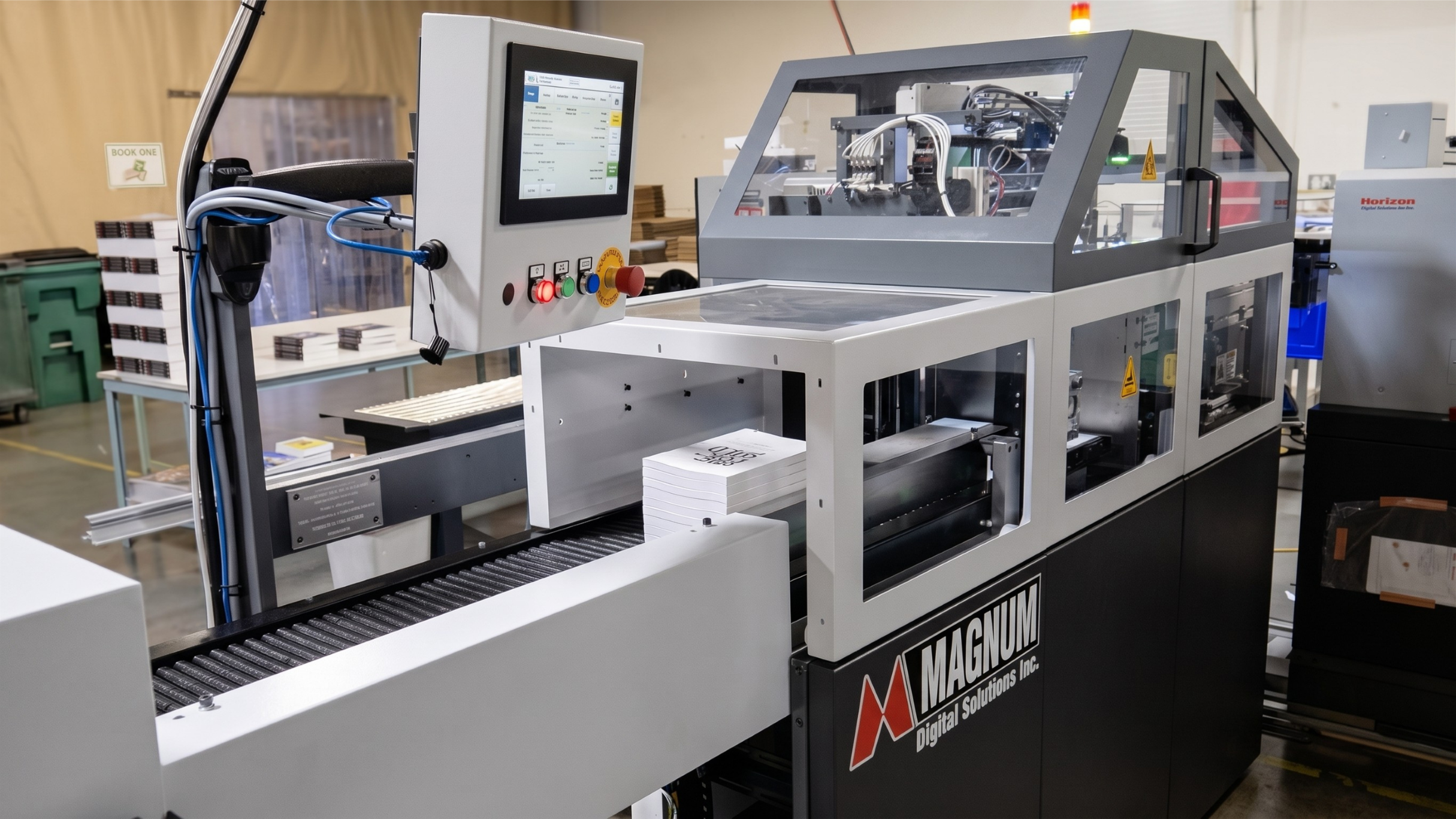
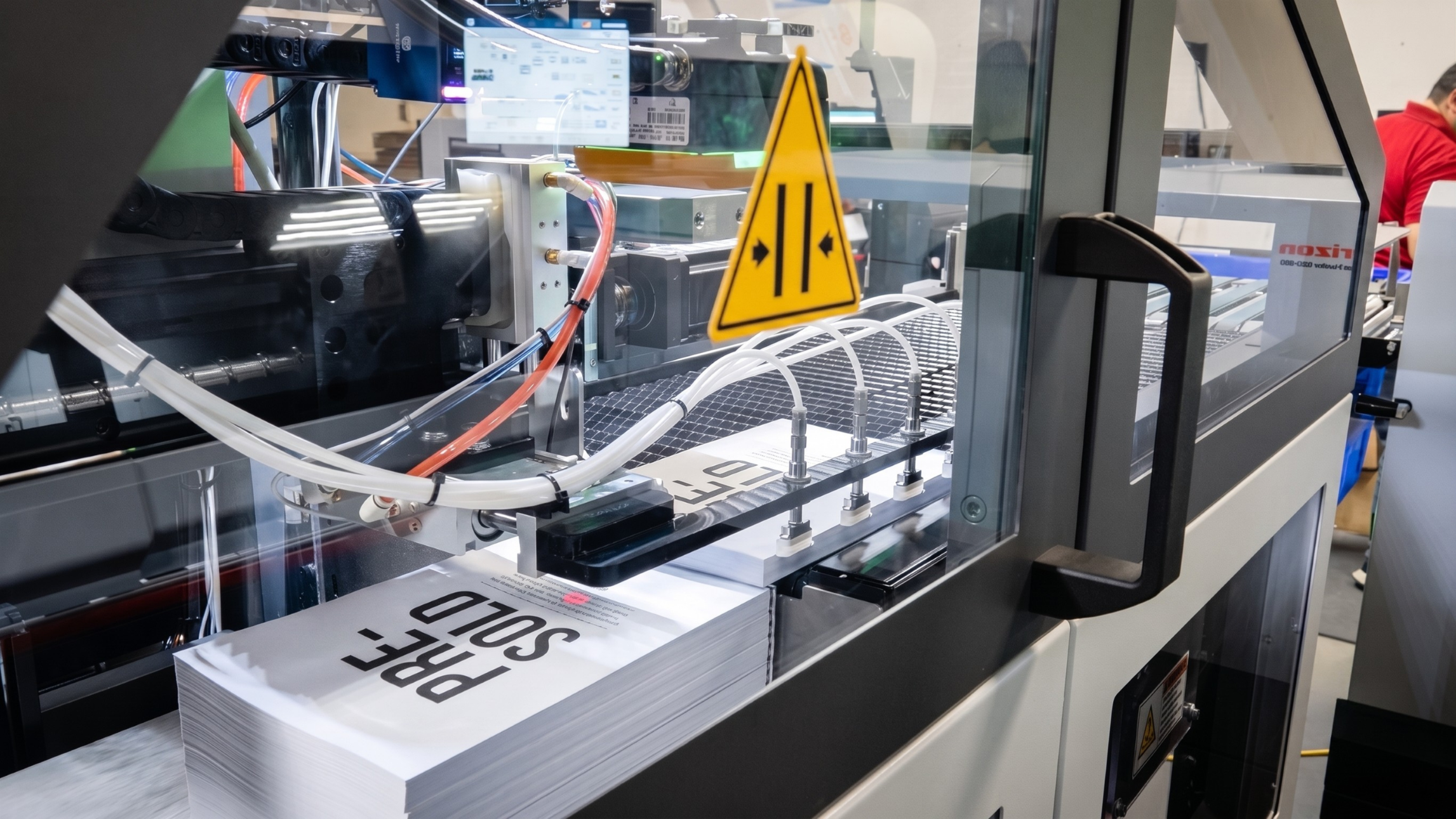
Magnum deployed the Flex Auto-Loader MK2 as a single unattended cell that consolidates de-stacking, block-level inspection, and binder feeding into one automated sequence. Rather than requiring an operator to hand-feed the binder, the Auto-Loader accepts stacked books at the infeed and handles the entire hand-off downstream: the elevator lifts blocks by thickness—pushing thick blocks and vacuum-feeding thin ones—then routes each block through a three-point inspection using top and bottom barcode readers plus a laser sensor to verify book-block integrity against encoded spec. Verified blocks feed straight onto the binder conveyor; any mismatch or out-of-spec thickness is ejected upstream into the reject bin before it can ever reach the binder. Because the cell handles 4, 6, and 8-page glued book blocks across formats from 4×6" up to 10.5×13" with no parts change, Acutrack's high-mix production floor can transition between jobs with a one-button start—no format retooling required. Magnum also integrated remote diagnostics and a lateral service track, so binder maintenance and any issue resolution can happen without downtime waiting for on-site support.
The Flex Auto-Loader MK2 transformed Acutrack's binder infeed from a manual, operator-bound bottleneck into a fully automated, verified, high-speed cell—lifting throughput from under 400 cycles per hour to a range of 1,100–2,000 cycles per hour, all while removing the operator from the feeding sequence entirely. Every block is now verified three ways before it reaches the binder, meaning mis-encoded or out-of-spec blocks are caught and ejected upstream instead of taking the line down. Operators previously tied to hand-feeding the binder are freed to run and monitor the broader line, and the format-agnostic design lets Acutrack move between page counts and trim sizes across their multi-title catalog without changeover parts or retooling delays.
Outcome highlights: